
A basketball jersey reads as clothing rather than gym kit once a layer fills the armhole and the hem stops above the thigh: crew-neck tee underneath, straight-leg denim below, low sneakers.
- The armhole is the problem, not the shirt. A men’s NBA medium is 39–41 in (99–104 cm) across the chest with no sleeve to break the line, so what sits underneath does most of the styling work.
- Length sets the look. That medium is 29.5 in (75 cm) from shoulder to hem — half an inch longer than a baseball jersey and long enough to cover the front pocket of a pair of jeans.
- Two colours, one of them neutral. The jersey arrives with a team palette; the rest of the outfit should agree with it rather than compete with it.
Free worldwide shipping over $57 · 30-day returns, first size swap free.
A basketball jersey arrives with a colour scheme, a number and a history already attached, which is exactly why it fights with everything else in the wardrobe. Worn with shorts and trainers it reads as kit. Worn with the right base layer and the right trouser it reads as the loudest, cheapest statement piece a person can own. The difference is not attitude, it is geometry: a sleeveless body with a deep armhole and a long hem changes where the eye stops. What follows is what that cut actually measures, what belongs underneath it, five outfits that survive daylight, and the point at which a bigger size stops helping.
Why does a basketball jersey look like gym kit off the court?
Five measurements explain the whole problem. A men’s NBA medium is 39–41 in (99–104 cm) across the chest, 29.5 in (75 cm) from shoulder to hem, and 18 in across the shoulders — and it has no sleeve at all. Every other jersey we cut closes the arm somewhere: a football medium runs 38–41 in (97–104 cm) with an 18.5 in sleeve, a baseball medium the same chest with the same sleeve, a hockey medium 43–46 in (109–117 cm) with a 25 in sleeve. Basketball is the only one that leaves the shoulder line and the upper arm exposed.
| League | Cut | Men’s M chest | Body length | Sleeve / shoulder | What it does to an outfit |
|---|---|---|---|---|---|
| NBA | Standard, slightly long | 39–41 in (99–104 cm) | 29.5 in (75 cm) | Shoulder 18 in | Arm and shoulder bare — needs a layer underneath |
| NFL | Roomy, boxy | 38–41 in (97–104 cm) | 30 in (76 cm) | Sleeve 18.5 in | Sleeve covers the deltoid, so it already reads as outerwear |
| MLB | Full, button-front | 38–41 in (97–104 cm) | 29 in (74 cm) | Sleeve 18.5 in | The button front splits the block — the easiest to wear open |
| NHL | Very loose | 43–46 in (109–117 cm) | 31 in (79 cm) | Sleeve 25 in | Widest body we sell; one size down keeps a clean line |
| Soccer | Athletic, slim | 37–40 in (94–102 cm) | 29 in (74 cm) | Slim through the waist | Sits closest to the body — layer it, do not size up |
Men’s M, body measurements from the league tables on our size guide. Body length is garment length, measured shoulder seam to hem.
Two of those numbers decide how the outfit will look. The shoulder figure — 18 in on a basketball medium — is where the seam lands, which is the widest point a layer underneath has to reach. The length figure is what the trouser has to answer: at 29.5 in (75 cm) on a 5 ft 10 wearer the hem sits near the hip bone, high enough to leave a belt visible and low enough to cover a waistband. A hockey jersey at 31 in (79 cm) covers the belt completely, which is why it layers over a hoodie and a basketball jersey does not. Hockey is also where the block changes shape rather than just growing: a men’s small is 40–43 in (102–109 cm) across the chest with a 30 in / 76 cm body, so it is roughly basketball length but a full size wider.
The bare shoulder is the part no amount of styling hides. On court the sleeveless cut exists so the arm can move; on a street it reads as sportswear because the eye follows an unbroken line from the neck to the wrist. Once a sleeve crosses that line at the bicep, the jersey stops being kit and becomes a top layer. That is the whole trick, and it costs one t-shirt.
What should you wear under a basketball jersey?
Underneath is where most of these outfits are won or lost, and the rules are short enough to memorise. Four of them cover every season we sell for.
- 1Crew-neck tee with sleeves to mid-bicep. It fills the armhole and gives the shoulder a horizontal line to sit against. White under a light jersey, black under a dark one.
- 2Fitted long-sleeve for cold weather. A slim sleeve slides through the armhole; a loose one bunches at the armpit and pushes the jersey out of shape by mid-morning.
- 3A hoodie only with one size up. A hoodie under a true-size jersey pulls the armhole tight and shortens the body — order one size larger, in any league.
- 4Nothing underneath belongs to the gym or the beach. Bare shoulders plus a jersey is the one combination that cannot be read as anything except sportswear.
The base layer also fixes the colour story before the trousers are chosen. A white tee under a loud jersey turns it into a two-tone outfit and gives the eye somewhere to rest; a black tee under a cream jersey does the opposite and makes the choice look deliberate. Either works, but the hem of the tee is visible at the hip, so it sets the horizontal line the whole outfit is read against. Getting that line wrong is what makes a good jersey look like a costume. The hoodie rule in particular has a longer version — the numbers per league, and what a hoodie does to the armhole — in our guide to sizing a jersey over a hoodie, which is worth reading before buying a size up for winter.
What are five basketball jersey outfits that work?
Each formula below is a complete outfit rather than a mood board: one base layer, one bottom, one shoe, and a reason the three hold together.
One: white tee and indigo denim. Cream or white jersey over a plain white tee, straight-leg indigo jeans, low canvas sneakers. The tee fills the armhole, the straight leg balances the wide chest, and nothing competes with the jersey’s own colours. This is the version to wear when you are not certain the jersey is welcome, and it works for any team in the NBA aisle.
Two: one colour, three textures. Black jersey over a black fitted long-sleeve, charcoal wide-leg trousers, black sneakers. Mesh, cotton and wool in the same hue is what stops all-black reading as a uniform. Push the long-sleeve cuff up so a sliver of wrist shows — it breaks the block at the armhole, which is where the eye is already looking.
Three: one loud shirt, everything else quiet. A saturated jersey needs one neutral underneath and one neutral below: white tee, light-wash denim, white sneakers. Skip the matching cap and the matching shorts. Two team-coloured pieces turn an outfit into a uniform, and three turn it into a costume. The rule holds in the retro and throwback aisles too, where the older palettes are louder by design and the neutral has to work harder. Why those older shirts ended up on the high street in the first place is a separate story, told in our vintage jersey streetwear guide.
Four: over a collar. A jersey over an oxford shirt with the collar left out, pleated trousers, loafers. The collar gives the neckline a finished edge and the pleats give the hem something to sit over rather than cling to. It is the only version here that reads as tailoring, and the one that survives a dinner.
Five: over a skirt. A women’s cut jersey over a white tee, pleated midi skirt, ankle boots. The women’s NBA medium measures 35–37 in (89–94 cm) across the chest and 27 in (69 cm) long — 2.5 in shorter than the men’s medium — so it ends at the waist instead of the hip and leaves the skirt’s waistband visible. That single difference is why the women’s cut tucks into a skirt and the men’s cut hangs over it.
 Golden State Warriors · The TownCity Edition fan jersey, tanFan version · NBA · Standard cutView this shirt
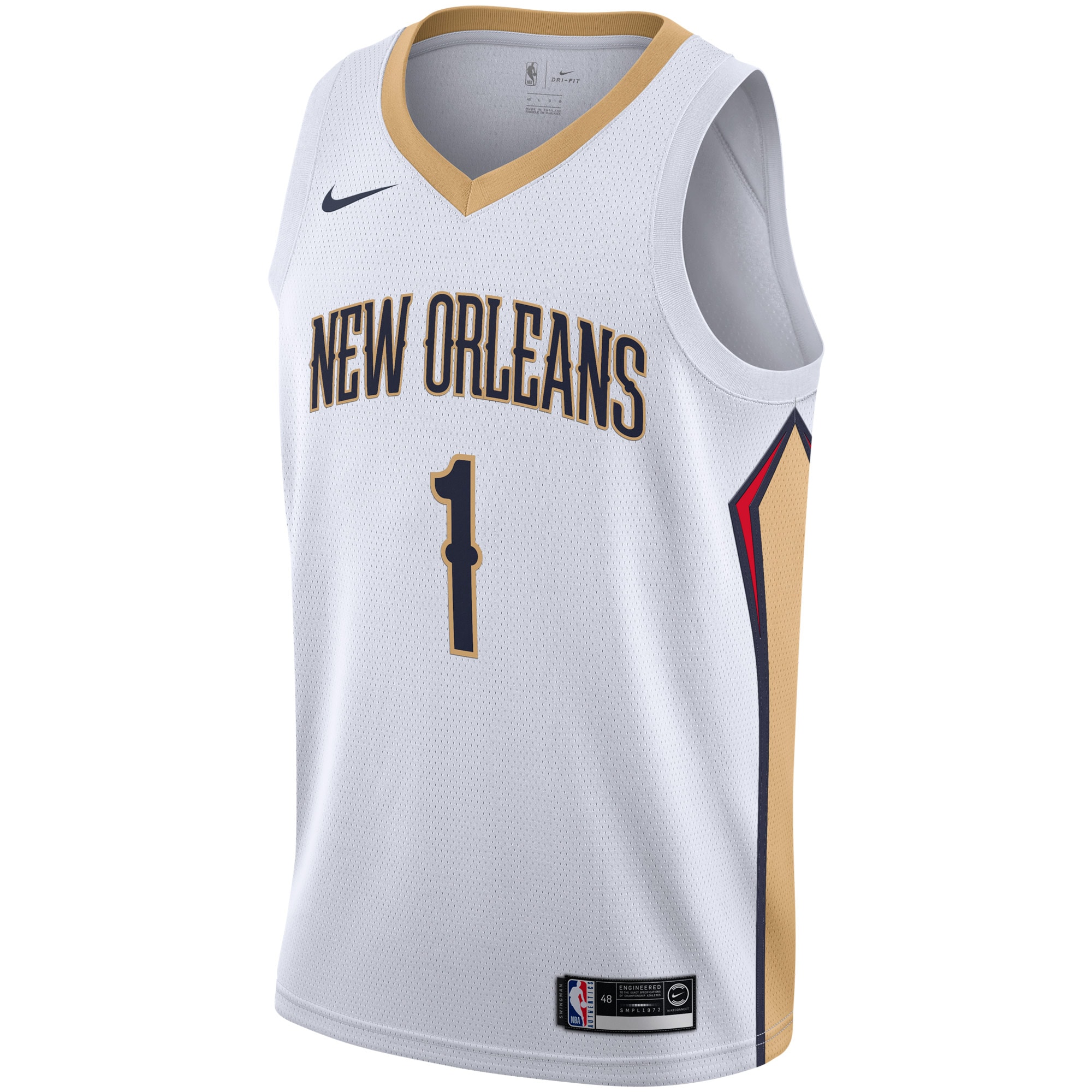 New Orleans Pelicans · AssociationAssociation fan jersey, white and goldFan version · NBA · Standard cutView this shirt
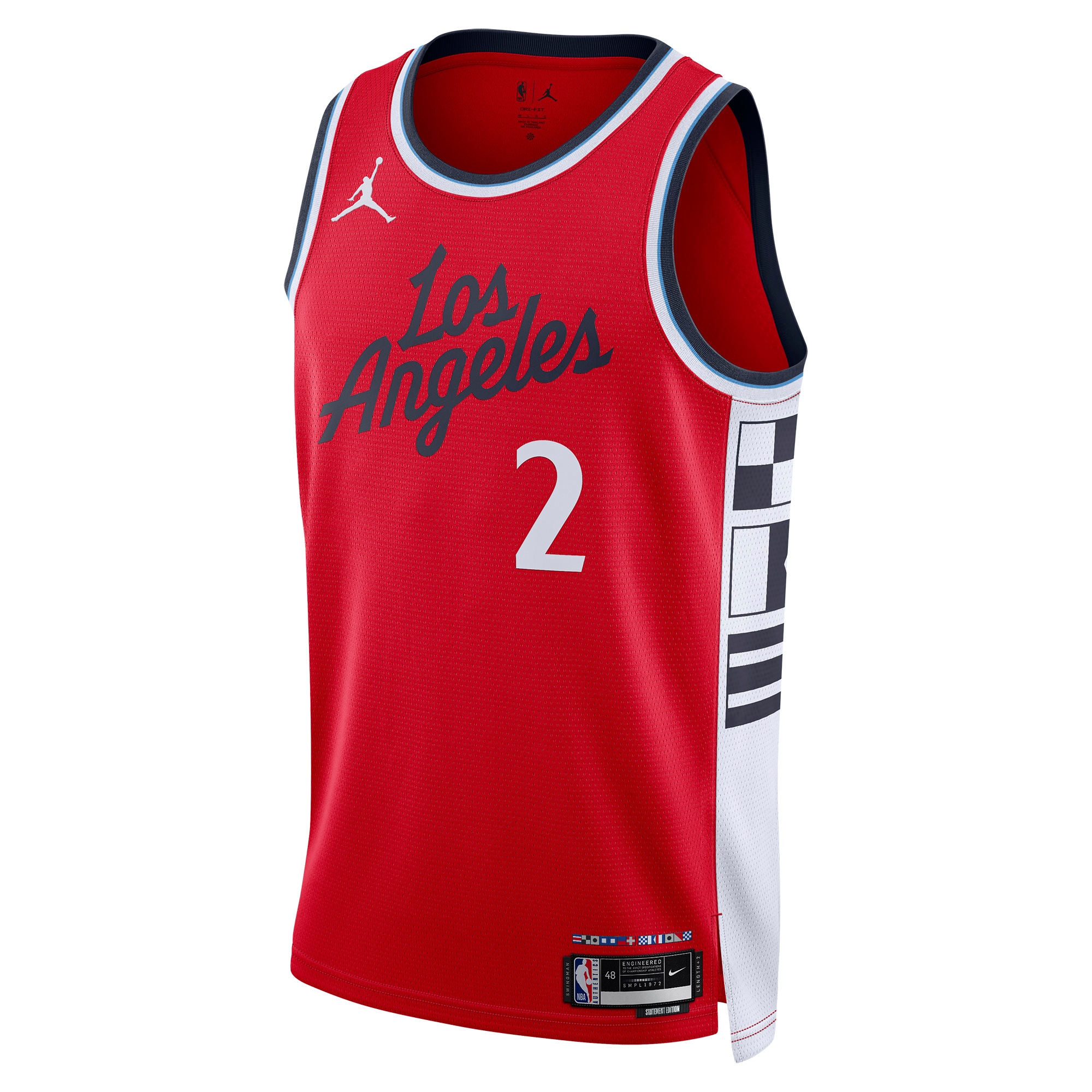 LA Clippers · StatementStatement fan jersey, redFan version · NBA · Standard cutView this shirt
Three colourways, three formulas: the Warriors tan city shirt for the white-tee outfit, the Pelicans white association shirt for the denim one, and the Clippers statement shirt in red for the version that keeps everything else neutral. All three sit in the standard basketball block at 39–41 in (99–104 cm) in a medium.
How do the colours fit together?
A jersey brings three or four colours with it, which leaves room for exactly two decisions: the neutral under it and the neutral below it. Keep the third colour as an echo of something already printed on the shirt — a trim colour, a number outline — and the outfit looks planned rather than assembled. It is also why a Lakers gold shirt is easier to wear than it looks: the purple and the white are already balanced inside the shirt, so the outfit only has to supply one neutral and get out of the way. Four palettes do the work on their own — the Bulls black and red, the Celtics kelly green, the Nuggets navy and gold and the Heat red — and each one is a colour block before anything is layered over it.
Which outfit suits which build?
The formulas do not change with body type, but the size inside them does. Four cases cover almost every question we answer about basketball jerseys.
Tall and broad, around 6 ft with a 44 in chest. Order the true size — an XL starts at 43 in (109 cm) and runs to a 31.5 in (80 cm) body, which is already generous. Pair it with a straight leg or a wide leg; a skinny jean under a boxy top makes the shoulders look borrowed. Sizing up here is the common mistake: it adds length where the body is already longest.
Short and narrow, under about 5 ft 7. Between two sizes our rule is to take the larger, but on a short frame the hem matters more than the chest: a men’s small is 28.5 in (72 cm) long, and that half-inch is the difference between a shirt and a tunic. Keep the small, wear it over a tee, and let the trouser carry the length. A women’s cut is the shorter alternative if the chest measurement allows it.
Women wearing the men’s cut. The men’s block is wider through the waist and 2.5 in longer in the body, which is what produces the oversized look people are usually after. If that is the aim, take the men’s shirt one size below your usual women’s conversion rather than your true men’s size — the shoulder stays where it belongs and the body still hangs loose.
Someone who is not a fan. Choose a neutral colourway with no nameplate, or a custom city shirt with their own name — up to 12 characters, produced in 5–7 business days plus 1–3 days of packing, with a digital mock-up sent in 1–2 days for approval first. The custom jersey page sets out that proof step, and the custom range carries the blank colourways to start from. A shirt with no team on it is a shirt; a shirt with somebody’s name on it is a gift.
Does the size change the outfit?
It changes it more than the colour does. One size up on a 29.5 in (75 cm) body adds roughly an inch and a half of length and turns a shirt that ends at the hip into one that ends at the thigh, which is where styling stops and dressing up starts. Between two sizes take the larger, with the one exception we give everywhere: the hockey cut is already the loosest we sell, so order the true size there. Adding a hoodie means one size up in any league, and nothing more.
For a fit that stays put, the rest of the wardrobe has to be decided first. Straight-leg denim or pleated trousers keep the line under the hem clean; tapered joggers pull it back towards the gym. The same shirt over a Bulls custom statement shirt or a black Curry swingman is the difference between two outfits, and neither of them needed a different size. Both are cut from the men’s block, and the men’s aisle lists the full ladder league by league if the chest measurement lands between two rows.
What if the fit is wrong?
It is an easy thing to fix. Orders leave in 1–3 business days and arrive in 7–15 business days with tracking; shipping is free worldwide over $57, starts at $5 below that and never exceeds $50 on a single order. Returns run 30 days with no restocking fee and the first size swap is free. Custom shirts are the exception — final sale unless they arrive damaged or misprinted — so settle the size before the name goes on. Orders of 10 pieces or more can be quoted at wholesale. The full policy, including how to start a swap, sits on our FAQ page.
FAQ
Can you wear a basketball jersey casually?
Yes, and the fix is one layer. A crew-neck tee under the jersey fills the deep armhole, and a straight-leg trouser changes the silhouette below the hem. Leave out both and the same shirt reads as gym kit, because the shoulders stay bare and the line from neck to wrist is unbroken.
What do you wear under a basketball jersey?
A crew-neck tee in summer and a fitted long-sleeve in winter. A hoodie only works with one size up, because a hoodie under a true-size jersey pulls the armhole tight and shortens the body. Bare shoulders under a jersey belongs to the gym or the beach, not to the street.
Should a basketball jersey be oversized?
One size up at most. A men’s medium is already 29.5 in (75 cm) long, so a second size up adds roughly three inches of body and turns the shirt into a dress. If the aim is the oversized look, buy the true size and take the trouser wider instead.
How do you style a jersey without looking like a fan?
Pick a neutral colourway, leave the nameplate off, and put a tailored bottom under it. A cream or black jersey over a white tee with pleated trousers reads as clothing; the same jersey with matching shorts and a cap reads as a costume.
SHOP NBA JERSEYS
Five cuts, thirty teams, one rule — fill the armhole, then choose the trouser.
SHOP THE NBA RANGE