

Brazil and Argentina are the two most successful national teams in South American football, and their current squads are built in opposite directions: Brazil named 26 players to start a new cycle, Argentina named 28 to close one.
- Watch Brazil for what comes next. Carlo Ancelotti’s first post-tournament squad is 26 deep, with Endrick (20) and Estêvão (19) in the attack and Neymar retired from international football.
- Watch Argentina for who is leaving. The 28-man list keeps almost the entire group that reached the 2026 final and brings back Lionel Messi for one last window.
- Then pick a side and a shirt. Both teams sell home, away, player-version and vintage cuts — the four shopper profiles below tell you which one is yours, and everything sits inside the National Teams range.
Free worldwide shipping over $57 · 30-day returns, first size swap free.
Five World Cups against three. The only nation to appear at every World Cup against the record holders of the Copa América. Brazil and Argentina have spent a century disagreeing about how football should be played, and the two squads named in September 2026 do not settle the argument — they restate it in different shapes. Brazil’s 26-man list is a rebuild: a coach under contract to 2030, two teenagers in the front line, and the country’s all-time leading scorer gone from the national team. Argentina’s 28-man list is a farewell: almost the whole group that reached the 2026 final, plus the No.10 for one last window. Here is what each squad actually is, who to watch on both sides, and which shirt makes sense for the way you watch.
Brazil vs Argentina teams: what actually separates them?
The squad lists are built on opposite principles, and the counts show it before any name does. Brazil named 26 players for a new cycle: 3 goalkeepers, 9 defenders, 6 midfielders and 8 forwards. Argentina named 28: 3 goalkeepers, 8 defenders, 11 midfielders and 6 forwards. One squad carries eight forward options and six midfielders; the other carries the reverse. Brazil are built to attack from wide areas and take risks. Argentina are built to control the middle of the pitch and win the moments that decide a tournament.
| Unit | Brazil (26 players) | Argentina (28 players) | What this unit decides |
|---|---|---|---|
| Goalkeepers | 3 — Hugo Souza, Pedro Morisco, Otávio | 3 — Emiliano Martínez, Gerónimo Rulli, Juan Musso | Argentina kept the same three; Brazil’s three are new to it, with Alisson and Ederson both left out of the list |
| Defenders | 9 — Arthur Dias, Douglas Santos, Gabriel Magalhães, Jair Cunha, Marquinhos, Matheuzinho, Mauro Júnior, Vitor Reis, Wesley | 8 — Agustín Giay, Leonardo Balerdi, Cristian Romero, Lisandro Martínez, Juan Foyth, Facundo Medina, Nicolás Tagliafico, Román Vega | How high each team can defend: both lists carry uncapped names in the back line |
| Midfielders | 6 — Andrey Santos, Breno Bidon, Bruno Guimarães, Danilo Santos, Douglas Luiz, Gabriel Bontempo | 11 — Enzo Fernández, Alexis Mac Allister, Valentín Barco, Giovani Lo Celso, Exequiel Palacios, Rodrigo De Paul, Nicolás Paz, Franco Mastantuono, Giuliano Simeone, Nicolás González, Matías Soulé | The clearest difference on the page — eleven against six. Argentina build through here; Brazil bypass it |
| Forwards | 8 — Endrick, Estêvão, João Pedro, Pedro, Raphinha, Rayan, Samuel Lino, Vinícius Júnior | 6 — Gianluca Prestianni, José Manuel López, Santiago Castro, Julián Álvarez, Lautaro Martínez, Lionel Messi | Whether the team stretches a defence with width (Brazil) or finishes a move it has already controlled (Argentina) |
Squad references follow the two lists announced in September 2026, the first of the new cycle for both countries: Brazil’s 26-man group under Carlo Ancelotti and Argentina’s 28-man group under Lionel Scaloni. Unit counts are as grouped on each list, ages are as of 27 September 2026, and heights are as listed on national squad databases. One change has since been reported in each group: Brazil replaced João Pedro, injured, with Martinelli of Fluminense, and Argentina added three domestic-based players. Match schedules and results are covered elsewhere on the site, not here.
Two numbers explain the two identities better than any badge. Brazil took eight forwards and six midfielders; Argentina took six forwards and eleven midfielders. When Brazil attack, they attack with width — Vinícius Júnior, Raphinha, Rodrygo, Estêvão and Rayan are all players who want the ball wide and one defender in front of them, and the whole shape is arranged so that one of them receives it there. When Argentina attack, they attack through the middle, in possession they already control: Enzo Fernández, Alexis Mac Allister, Rodrigo De Paul, Nicolás Paz and Franco Mastantuono are five central players for the same three shirts.
The historical version of the same argument: Brazil’s five titles came from individual creation on the wings — Garrincha, Jairzinho, Ronaldinho, Rivaldo, and now a front line that all wants the ball wide. Argentina’s three titles came from a No.10 and a structure around him — Kempes, Maradona, Messi — plus a level of tournament pragmatism that Brazil have rarely been willing to accept. Neither approach is a shortcut. It is simply the answer to a different question, and you can usually tell which one a squad believes in by counting the midfielders.
This guide covers squad structures, roles and shirt choices only. Match schedules and results are covered elsewhere on the site.
- Record five World Cup titles (1958, 1962, 1970, 1994, 2002) and the only nation at every World Cup
- Eight forwards in a 26-man squad, five of them one-on-one wide players
- A new cycle under Carlo Ancelotti, contracted to 2030
- World Cup winners in 1978, 1986 and 2022, and a record 16 Copa América titles
- Eleven midfielders in a 28-man squad — the tightest central unit either team has named
- The same head coach since 2018, and the 2026 final as the reference point
Same continent, opposite squads. Count the midfielders and you can tell which team a coach expects to control the ball.
Who are the Brazil players to watch?
Start with the two players who decide the tempo, then the two teenagers who decide how the next cycle is judged. Brazil’s attacking group is younger than its reputation: the oldest regular forward is 29, and two of the eight were born after 2005.
The absences define this squad as much as any inclusion. Neymar, Brazil’s all-time leading scorer, has retired from international football — and he leaves as one of only two Brazilians, alongside Pelé, to have scored at four different World Cups, which is the kind of line that sums up a generation in a single sentence. Then there is the rest of the last cycle: Alisson, Ederson, Casemiro and Fabinho are all left out entirely, which is why the squad has a new goalkeeping department and why only two of the 26 players are over 30. For buyers that creates an odd but useful situation — the Casemiro and Gabriel Martinelli shirts are still among the Brazil shirts people search for even though neither player is in this list.
Who are the Argentina players to watch?
Argentina’s list has one obvious headline and one structural story underneath it. The headline is the captain, who has announced his retirement from the national team and plays one final match for Argentina in this window. The structural story is the midfield, where eleven players are competing for three shirts and the next generation is already in the room.
Around them: Emiliano Martínez remains the No.1 at 34, Cristian Romero is the defender the whole structure is built to protect, and Nicolás Otamendi at 38 is back for one more window, which is either sentiment or insurance depending on how you read a squad list. The two names to learn now are Nicolás Paz, 22, and Franco Mastantuono, 19 — both were given their first senior football by this coaching staff and both are central players rather than wingers, which tells you what the post-Messi Argentina is designed to look like. The Cristian Romero range covers the defending half of that plan.
- World Cup winner in 2022 and captain since 2011
- Has announced his retirement from international football
- One final appearance for Argentina in this window
- The player Brazil’s whole attacking structure is built to feed
- The latest in a line of Brazilian wide forwards that runs back to Garrincha and Jairzinho
- At 26, he should be at his peak for the 2028 and 2030 tournaments
The two squads are at opposite points in the same cycle: one is closing its greatest era, the other is opening its next one.
| Player | Team | Position | Age (Sep 2026) | Height | What to watch |
|---|---|---|---|---|---|
| Vinícius Júnior | Brazil | Forward (left) | 26 | 176 cm / 5 ft 9 in | How often he receives the ball inside the final third rather than 40 metres out |
| Raphinha | Brazil | Forward (wide) | 29 | 176 cm / 5 ft 9 in | Whether the right side stays a genuine threat or becomes a decoy for the left |
| Rodrygo | Brazil | Forward | 25 | 174 cm / 5 ft 9 in | Whether Brazil look like a combination or three individual duels when he plays |
| Endrick | Brazil | Centre-forward | 20 | 173 cm / 5 ft 8 in | Minutes, not goals — a 20-year-old centre-forward tells you the plan is long |
| Lionel Messi | Argentina | Forward (captain) | 39 | 170 cm / 5 ft 7 in | Where he receives the ball: his positions, not his speed, are what the team is built on |
| Julián Álvarez | Argentina | Forward | 26 | 170 cm / 5 ft 7 in | How much of the pressing and running the team is prepared to hand him |
| Lautaro Martínez | Argentina | Centre-forward | 29 | 174 cm / 5 ft 9 in | Whether Argentina keep a fixed centre-forward or use him to overload the middle |
| Enzo Fernández | Argentina | Central midfield | 25 | 178 cm / 5 ft 10 in | Who takes responsibility for tempo once the No.10 is not there to do it |
Ages are as of 27 September 2026; heights are as listed on national squad databases. Watch points are ours, based on how each squad is built — not on results.
Which Brazil or Argentina shirt should you buy?
Both teams sell the same four kinds of shirt, so the decision is really about which of the four buyers you are: the one who wants today’s name, the one who wants the player-version cut, the one who wants the era rather than the season, and the one who is buying for someone else.
1. You want the shirt of the player who decides the match. That is the Brazil home shirt with Vinícius Júnior 7 or the Argentina home shirt with Lionel Messi 10. If you would rather wear the other winger, the Brazil away shirt with the same number is the same player in the change kit. All three are fan version / replica cuts: shirt first, name second.
2. You want the player-version feel. Look for the match-cut version of the same design — a lighter, perforated fabric and a closer, more athletic body, which is what the Brazil match shirt and the Argentina authentic home shirt are. Sizing is the trap: a soccer shirt is the slimmest cut we sell, so if you want the relaxed drape that a football or hockey jersey gives you for free, take one size up rather than stopping at your usual label. Full chest and body measurements by size are on our size guide.
3. You want the era, not the season. Buy the shirt that carries a moment instead of a year: the 2022 World Cup winners home shirt on this page is the version with the third star, and the vintage Argentina away shirt from the early 2000s is the opposite kind of buy — something you wear because it does not look like kit. For the Brazilian side of the same idea, the Pelé, Ronaldinho and Kaká ranges run three World Cup generations between them, and the retro collection holds the rest.
4. You are buying for a smaller frame or for someone else. Youth sizes run to roughly 5'6" (168 cm) and a 34–36" chest, which covers most of the Brazil and Argentina kids shirts — the Argentina kids home shirt with the 10 on the back is the obvious gift, and above that size you move to a men’s S. Women’s cuts are tapered; if you want the classic oversized look, order a men’s size instead. If the size is a guess, the risk is small: 30-day returns with no restocking fee, and the first size swap is free. Want a different name? Build it on our custom jersey page — nameplates take up to 12 characters (A–Z, 0–9, spaces and hyphens), are produced in 5–7 business days plus 1–3 days of packing, and are final sale unless they arrive damaged or printed incorrectly.
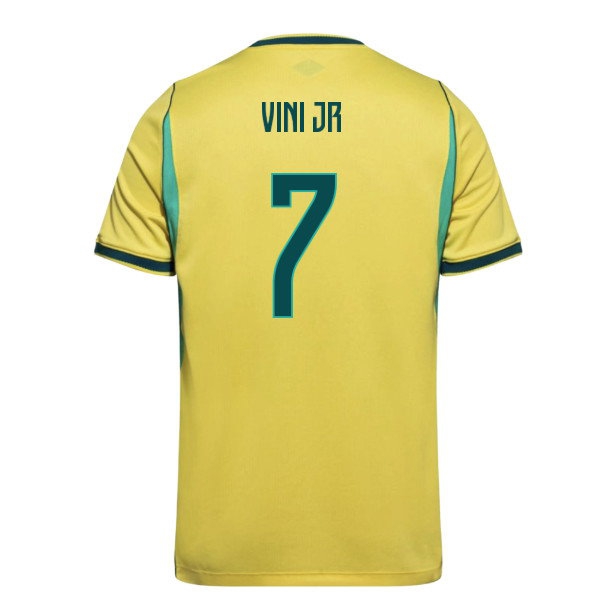 Brazil2026-2027 Home Shirt (Vini JR 7)Fan edition · Home · 2026-27 · International · MenView this shirt
 Argentina2026-2027 Home Shirt (Messi 10)Fan edition · Home · 2026-27 · International · MenView this shirt
 Argentina2022 World Cup Winners Home Shirt (MESSI 10)Fan edition · Home · 2022-23 · International · MenView this shirt
Orders leave our warehouse in 1–3 business days and arrive 7–15 business days later with tracking, free worldwide over $57. Below that threshold shipping starts at $5 and never exceeds $50 on a single order, so ordering both shirts together usually costs less than ordering them one at a time. Returns run to 30 days with no restocking fee, and the first size swap is free.
One last thing worth knowing before you choose a side. Brazil shirts are the slimmer buy of the two nations only in the sense that every soccer shirt is — the same slimmest cut in the shop, so if you normally wear football or baseball jerseys (roomy) or hockey jerseys (the loosest fit we sell) you will want one size up here rather than assuming the label carries over. Between two sizes, take the larger one. The other rule does not change either: squads get rebuilt every window, but the roles that make these two teams interesting — the wide creator in yellow, the central playmaker in sky blue — have survived every one of them. Both sides of that argument are in the Brazil and Argentina ranges.
If you take one thing from this guide, take the order of operations: decide which of the two identities you actually enjoy watching, then buy the shirt that plays that role. Brazil will always be the team that attacks with width; Argentina will always be the team with a No.10 at the centre of it. The names change every cycle. The argument does not.
FAQ
What is the difference between the Brazil and Argentina teams?
There are two measurable differences. Brazil have won the World Cup five times (1958, 1962, 1970, 1994, 2002) and are the only nation to have played at every World Cup; Argentina have won it three times (1978, 1986, 2022) and hold the record of 16 Copa América titles. Then there is how they build: Brazil’s current 26-man squad carries 8 forwards and 6 midfielders, while Argentina’s 28-man squad carries 6 forwards and 11 midfielders — width against control.
How many players are in the Brazil and Argentina squads?
Brazil named 26 players in September 2026: 3 goalkeepers, 9 defenders, 6 midfielders and 8 forwards, the first squad of Carlo Ancelotti’s cycle towards 2030. Argentina named 28: 3 goalkeepers, 8 defenders, 11 midfielders and 6 forwards — the first list after the 2026 World Cup, and the window in which Lionel Messi plays his final match for the national team.
Is Lionel Messi still playing for Argentina?
He has announced his retirement from international football and is in the squad for one last window, with his final appearance for Argentina scheduled in these fixtures. He leaves as a World Cup winner with Argentina in 2022, a Copa América winner, and the captain since 2011 — which is why the Argentina home shirt with the 10 on the back is the one most buyers will keep.
Are Brazil and Argentina shirts a slim fit?
Both are soccer national-team shirts, which is the slimmest cut we sell — a fan version or replica shirt sits close to the body. If you want the looser, boxier look that a football or baseball jersey gives you out of the box, take one size up; between two sizes, take the larger one. The only shirts where we say the opposite are hockey jerseys, which are the loosest fit in the shop. Full measurements by size are on our size guide.
Pick a side, then pick a shirt
Brazil and Argentina shirts across home, away, player version and vintage — fan version, replica and authentic-feel cuts, nameplates up to 12 characters. Free worldwide shipping over $57 · 30-day returns · first size swap free.
SHOP THE ARGENTINA COLLECTION

