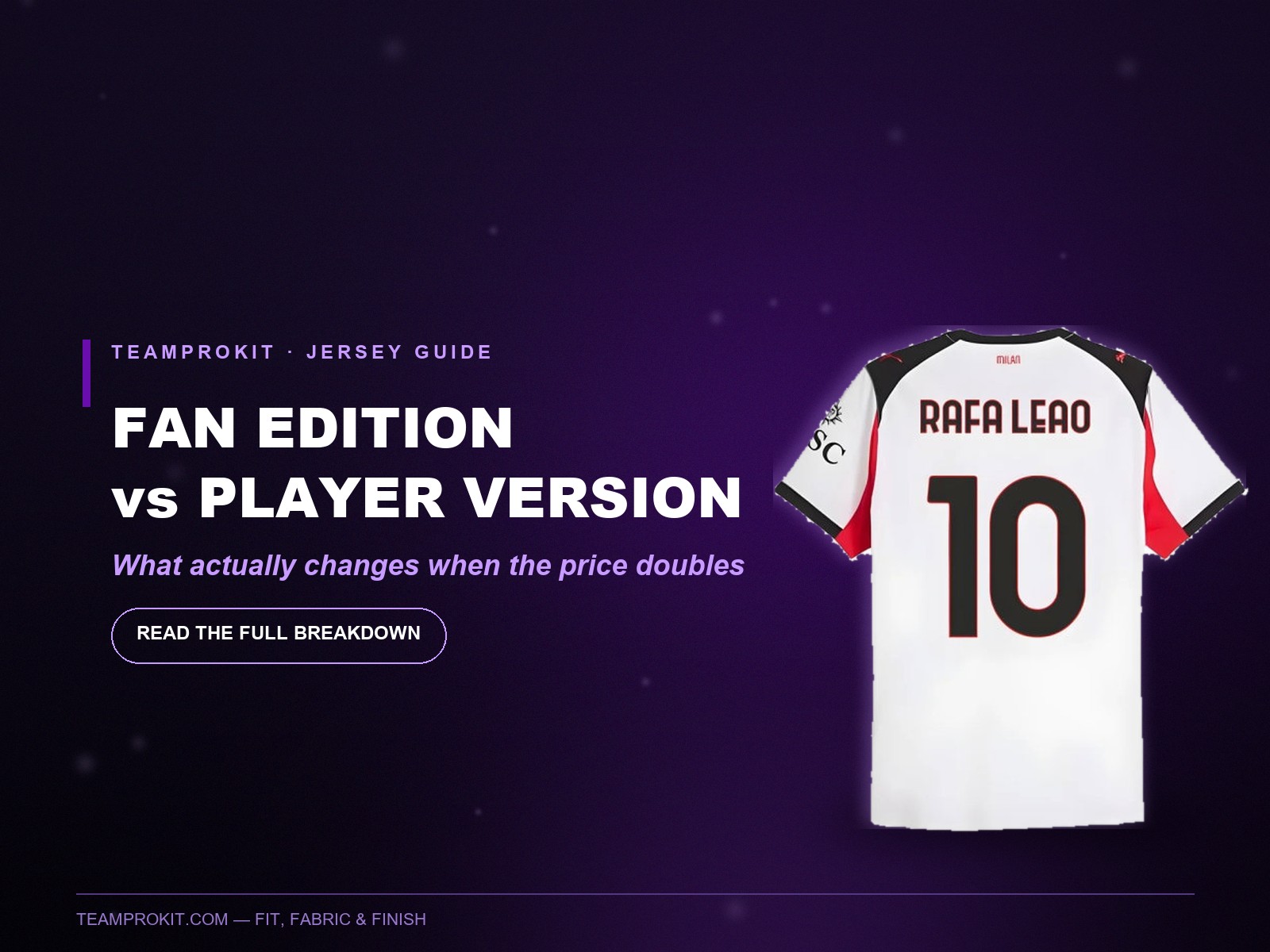

Buy the home colourway first: it is the shirt a club wears in its own building and the one most fans picture. Buy the away shirt second, when you want a lighter shirt that sits under a jacket instead of announcing itself.
- Every league decides differently. The NFL lets each home club choose white or its team colour and the visitor wears the opposite; the NHL has been dark at home since 2003–04; the NBA dropped home and road labels in 2017–18; baseball runs white at home and grey on the road.
- Away does not mean white. It means the shirt built to avoid a colour clash — grey in baseball, a club’s second colour in soccer, and sometimes nothing at all, because the home club already chose white.
- The colourway never changes the fit. A men’s medium is 38–41 in (97–104 cm) across the chest in an NFL shirt in either colour, and 43–46 in (109–117 cm) in hockey, because the hockey block is the loosest of the five.
Free worldwide shipping over $57 · 30-day returns, first size swap free.
Two shirts, one crest, the same size label — and only one of them is worn at home on a Sunday afternoon. The away shirt exists for one reason: contrast. Everything else about it, from the shade of white to the way the numerals are printed, follows from that single job. Which is why “home or away” is not a taste question. It changes what you are actually buying: the shirt a club wears in front of its own crowd, or the shirt built to stay legible against somebody else’s colour. The rules behind that choice differ by league, and two of them have been rewritten since 2003. So before the wardrobe argument, here is what each league really does — and which of the two shirts earns its place first.
How does the home and away jersey split actually work?
Only two of the five leagues run a fixed rule, and they run it in opposite directions. Start with football, because it is the one most people assume they know. The NFL’s playing rules say the home club chooses its jersey colour — white or its own team colour — for each home game, and the visiting club must wear the opposite. Clubs file those choices before 1 July. So “away means white” is a default, not a law: the Dallas Cowboys have built an identity on wearing white at home, the Miami Dolphins stay white almost year-round, and several southern clubs choose white early in the season for a plain physical reason — white reflects sunlight, dark colours absorb it.
Hockey runs the other way, and it is the cleanest rule of the five. Since 2003–04 the NHL home team wears its dark colour and the road team wears white; before that season it was reversed for three decades. That single date is the reason a white hockey shirt from the 1990s is a home shirt and a white one from this season is a road shirt — the same colour, a different job.
Baseball is a convention rather than a rule: white or cream at home, grey on the road, with coloured alternates at each club’s discretion. That is why an MLB home shirt can be cream and why one club’s road shirt is brown. Basketball is the outlier — since 2017–18 the NBA has no home and road designations at all: the home team picks from its own set and the visitor picks a contrasting one. The old home white survives as the Association edition, the old road colour as the Icon edition, and either can be worn in either building.
Soccer is the simplest to explain and the hardest to predict. The home shirt is the club’s primary identity; the away shirt exists to avoid a clash with the opponent or the referee; a third shirt covers whatever is left. It is also the league where the away shirt is most likely to be a design statement rather than a paler copy — which is how Juventus ended up with a pink away shirt in the current range.
| League | Home colourway | Away colourway | Who decides | What it means when you buy |
|---|---|---|---|---|
| NFL | White or team colour | The opposite of the home choice | Home club, filed before 1 July | A white shirt can be a home shirt |
| MLB | White or cream | Grey (club alternates excepted) | Club | Grey is the real road colour |
| NBA | Any set; white = Association | Any contrasting set | Home team picks, visitor contrasts | No fixed away colour since 2017–18 |
| NHL | Dark since 2003–04 | White (yellow in one historic case) | League rule; exceptions on request | White means road in hockey |
| Soccer | Primary club colours | Secondary kit, worn only to avoid a clash | Club and competition rules | Away is a separate design, not a shade |
League conventions as of October 2026, checked against the NFL playing rules (home club chooses white or team colour, visitor wears the opposite) and the NHL’s post-2003–04 home-dark rule. Colourway does not change sizing or fabric — the rows for that are in our size guide.
So is the away jersey always white?
No — and this is where most buying advice goes wrong. White is the default in two leagues (football and hockey) and a memory in a third. In baseball the road shirt is grey. In soccer the away kit is whatever the club decided would not clash, which is how a pink away shirt ends up being the most interesting shirt in a club’s range. And in football, a white shirt can be the shirt a team wears at home all season.
The practical version: if you want a white jersey, shop the NFL and NHL away ranges. If you want the shirt a team wears most often in its own building, shop the home range. If you want the design that stands apart from everything else in the wardrobe, the soccer away kit is usually the one — and the retro range is where the older, louder versions live.
What actually changes when the ground colour changes
Two things, and neither of them is the fit. The first is ink. On a white or grey ground the numerals are printed in a dark colour, so the edge of every character is the whole design: a slightly soft edge on a white shirt reads as a cheap print from three metres away, in a way the same edge never does on a dark ground. On a dark ground the numerals are white and usually outlined in a second colour, and that outline is what keeps them readable at distance.
The second is what the shirt has to hide behind. A white ground hides nothing — the collar rib, the shoulder seam and the print edge are the only detail there is, so all three have to be clean. A dark ground gives you contrast for free. If you want to judge a print job before you commit to a colourway, judge it on the white shirt; our fan version comparison walks the same question for print methods rather than colours.
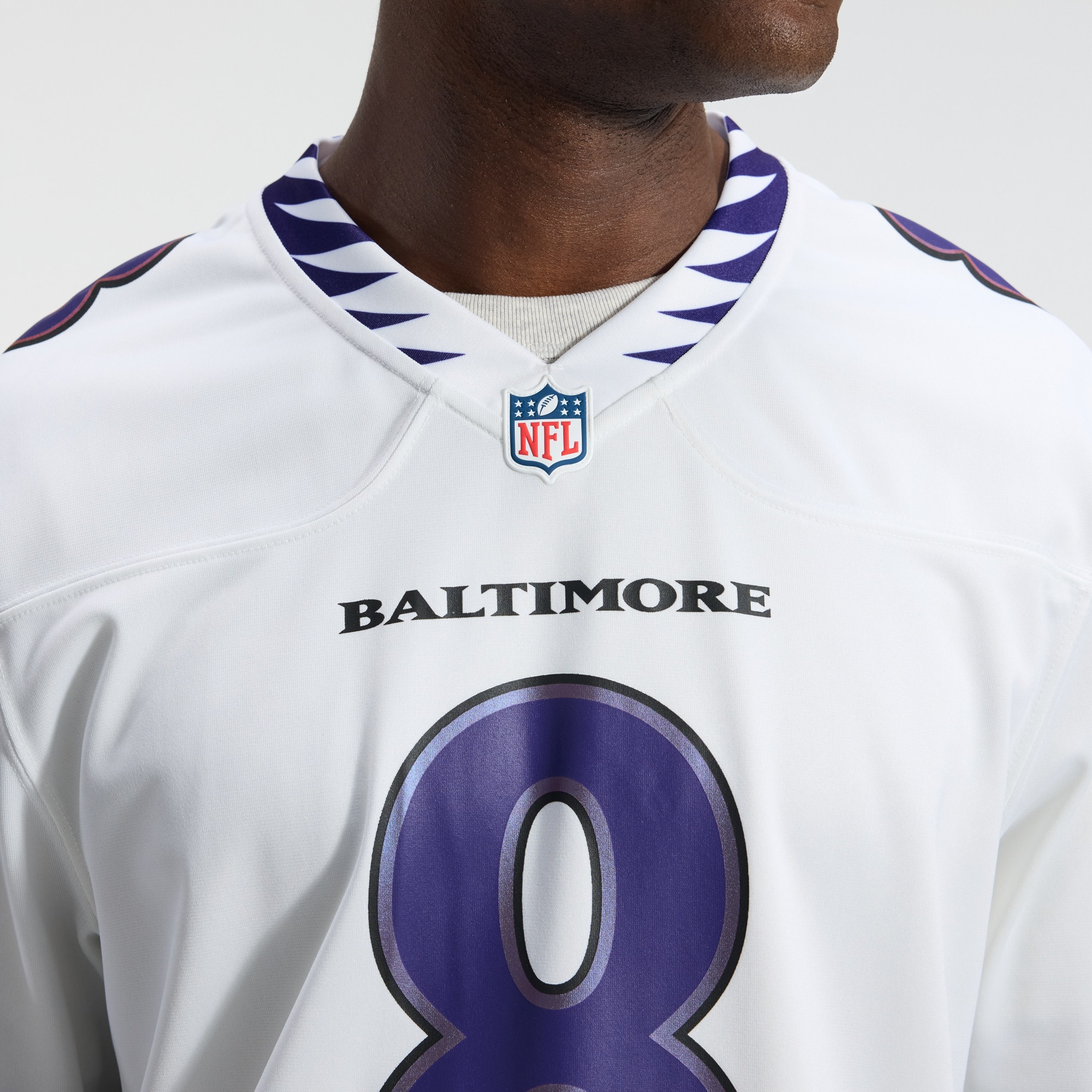

Both shirts are NFL game jerseys; the difference in what you can see is the ground colour, not the grade. The Baltimore Ravens shirt is the white one, the Kansas City Chiefs shirt the red one.
Does the colourway change the fit?
No. Colour is a dye, not a pattern block. A men’s medium NFL shirt measures 38–41 in (97–104 cm) across the chest and 30 in / 76 cm in the body whether it is white, red or black. What changes between leagues is the block itself, and that is where most size mistakes start: the same medium in hockey is 43–46 in (109–117 cm) with a 25 in sleeve, because hockey is the loosest cut of the five. The smallest hockey shirt, a small, already measures 40–43 in (102–109 cm) — wider across the chest than an NFL medium.
| League | Men’s M chest | Men’s M body | Sleeve / shoulder | Colourway effect |
|---|---|---|---|---|
| NFL | 38–41 in (97–104 cm) | 30 in (76 cm) | 18.5 in sleeve | None |
| MLB | 38–41 in (97–104 cm) | 29 in (74 cm) | 18.5 in sleeve | None |
| NBA | 39–41 in (99–104 cm) | 29.5 in (75 cm) | 18 in shoulder | None |
| NHL | 43–46 in (109–117 cm) | 31 in (79 cm) | 25 in sleeve | None |
| Soccer | 37–40 in (94–102 cm) | 29 in (74 cm) | US 38–41 / EU 48–50 | None |
Men’s medium, read directly off the league tables on our size guide on October 23, 2026. If you are between two sizes, go up — the one exception is hockey, which is loose enough to order at your true size.
What does change with colour is care. A white or light-grey shirt shows a mark the moment it happens, so it gets washed sooner, on its own the first time, in cool water and inside out. A dark shirt hides the small stuff and gets washed less often, which is quietly better for the print. Either way the rules are the same: no fabric softener, no dryer, nothing hot directly on the numerals — our wash and care guide covers the sequence step by step.
Dispatch and returns do not depend on the colourway either. Stocked shirts leave us in 1–3 business days and arrive in 7–15 business days with tracking; shipping is free worldwide over $57, starts at $5 below that and never exceeds $50 on a single order. Returns run 30 days with no restocking fee, and the first size swap is free.
Who should buy which — five buyers
Almost every message we get about home and away is really one of five questions. None of them is about taste.
This is your first shirt for the team. Buy the home colourway. It is what the club wears in its own building and what appears in every photo you will want to be in. In hockey that means the dark shirt; in baseball the white one; in football check first whether your club is one of the white-at-home sides, because then the home shirt is the white one and the “away” shirt is the colour.
You already own the home shirt. Buy the away. It is a genuinely separate design — different ground, different numeral treatment, often a different collar — so it is a second shirt rather than a duplicate of the first.
You wear it as clothing, not as kit. Buy the lighter one. A grey or white shirt sits under a jacket and over jeans without announcing itself; a saturated home shirt is the loudest thing in the outfit by default. Our layering guide builds three outfits around exactly that difference.
You watch outdoors in heat. Buy white. This is not a style opinion — it is the same reasoning NFL clubs use when they choose white for early-season home games, because a white surface reflects sunlight while a dark one absorbs it.
It is a gift and you are guessing. Buy the home colourway in the size that matches the chest measurement you can get. It is the shirt the person is most likely to have seen their team wear, and the returns window covers the guess: 30 days, no restocking fee, first size swap free.
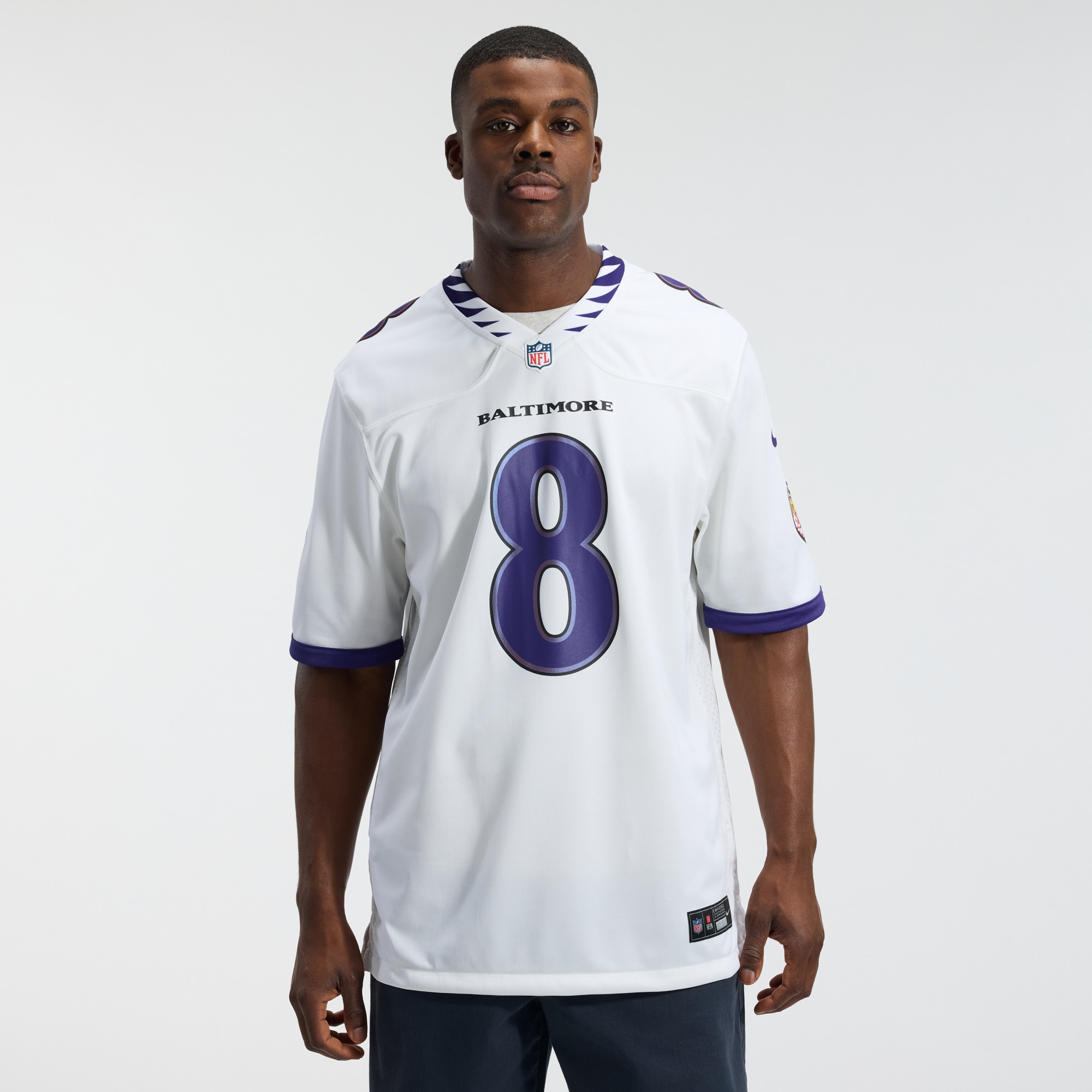 Baltimore Ravens · NFL awayRavens away jersey, whiteFan version · NFL · Roomy cutView this shirt
 Kansas City Royals · MLB roadRoyals road jersey, greyFan version · MLB · Full button-frontView this shirt
Two road shirts, two different answers to the same problem. The Ravens away shirt is white because football away shirts usually are; the Royals road shirt is grey because that is what baseball actually wears on the road, and grey hides a rainy Tuesday better than white ever will.
 Edmonton Oilers · NHL homeOilers home jersey, royalFan version · NHL · Loosest cut of the fiveView this shirt
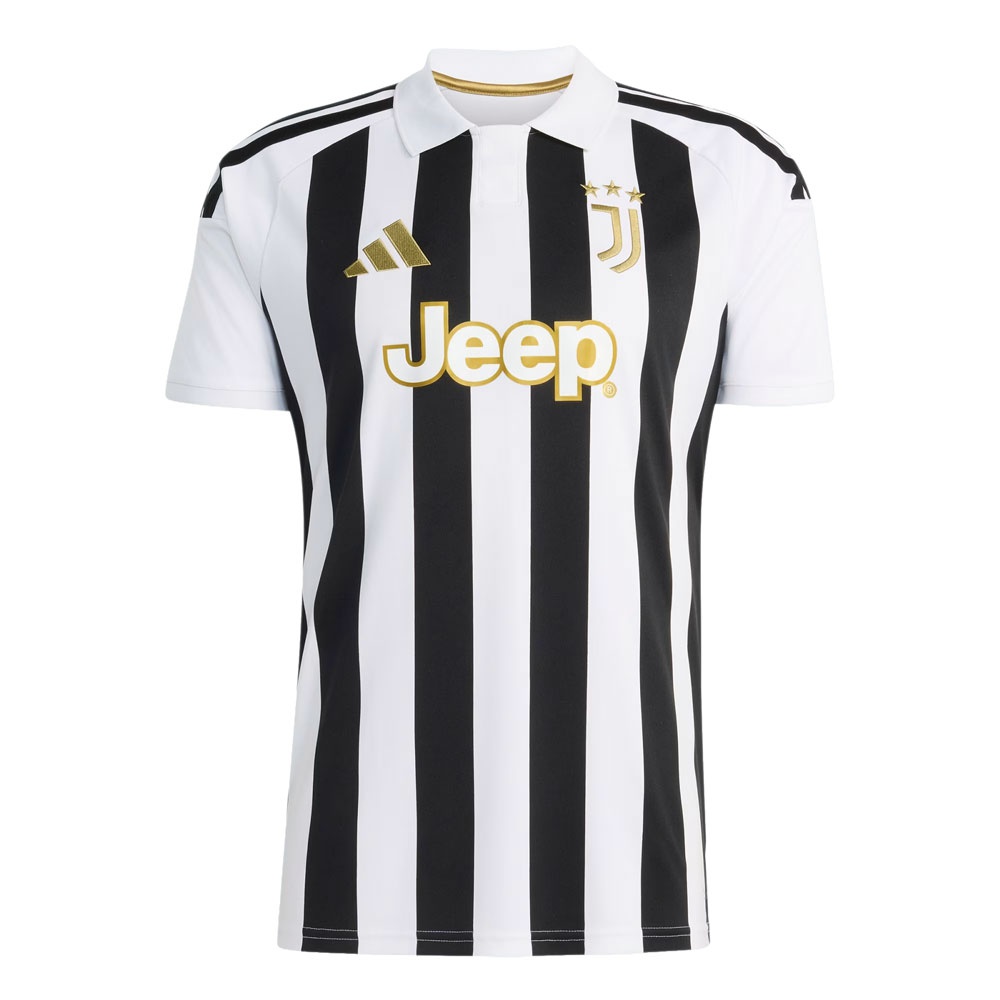 Juventus · 2026-27 homeJuventus home shirt, black and whiteFan version · Soccer · Slim cutView this shirt
The home half of the same argument. The Oilers home jersey is the dark home shirt hockey has required since 2003–04; the Juventus home shirt is a home shirt that is neither white nor a single colour, which is exactly why soccer is the league where “home” still means something distinctive.
Three more road shirts worth a look if the grey-and-white end of the wardrobe is where you are heading: the New York Yankees grey road shirt from the Yankees range and the Los Angeles Dodgers grey road shirt from the Dodgers range — both proper road colourways rather than a home shirt in a paler dye — and the Philadelphia Eagles white shirt from the Eagles range, which is the white-at-home example in football made concrete.
If the shirt is going to carry a surname rather than a squad number, the colourway matters less than the nameplate: personalisation takes 5–7 business days, then 1–3 days of packing, so it leaves us 6–10 business days after you approve the mock-up, and the name is capped at 12 characters (A–Z, 0–9, spaces and hyphens). The custom jersey page explains the process and the FAQ answers the rest; the printed and blank range sits in custom jerseys. National team shirts follow the same rule as clubs — home first, away second — and the national teams range is where those live.
FAQ
What is the difference between a home and an away jersey?
The away jersey exists to avoid a colour clash, so it is defined by contrast rather than by colour. In the NFL the home club chooses white or its team colour for each home game and the visitor wears the opposite; the NHL has worn dark at home and white on the road since 2003–04; baseball runs white at home and grey on the road; the NBA dropped the home and road labels entirely in 2017–18. The measurements are identical in both colourways.
Is the away jersey always white?
No. White is the away default in football and hockey, but baseball’s road shirt is grey, and in soccer the away kit is whatever the club chose to avoid a clash — which is why some away shirts are pink, yellow or black. In football a white shirt can even be the home shirt: the home club picks its colour for each game, and several clubs pick white.
Do home and away jerseys fit the same?
Yes. The colourway does not change the pattern block. A men’s medium is 38–41 in (97–104 cm) across the chest in an NFL or MLB shirt, 39–41 in (99–104 cm) in basketball, 37–40 in (94–102 cm) in soccer and 43–46 in (109–117 cm) in hockey, in either colour. Between two sizes, go up; hockey is the exception and takes your true size.
Which should I buy first, the home or the away jersey?
The home shirt, unless you already own one. It is the colourway a club wears in its own building and the one people recognise first; the away shirt is the better second buy, because it is a separate design rather than a duplicate. If the size is a guess, the returns window covers it: 30 days, no restocking fee, and the first size swap is free.
SHOP HOME & AWAY JERSEYS
Every league, both colourways — free worldwide shipping over $57, 30-day returns and the first size swap free.
SHOP ALL JERSEYS